
Exploring the Window of Agency
Understanding Our Reactions to Stress and Trauma
Recently, I have been observing and reflecting on my own reactions to events at the family, community, national, and global levels. There is so much to process emotionally, and at times, it can feel overwhelming. When this happens, we might seek out distractions—sometimes through social media, sometimes by analyzing recent events, or by immersing ourselves in the latest series on Netflix.
It is important not to demonize the act of dissociation. Disconnecting from stress and trauma is an important survival response that has an important place and supports us in being able endure difficult times. Other survival responses include fighting, fleeing, or the tendency to fawn and appease.
I deeply believe there is wisdom in the varied ways we respond to trauma and stress, both individually and collectively. For example, during last year’s Hurricane Helene in WNC and the recent ICE raids that threatened our community, I found myself cycling through all of these responses at different times. In fact, with the rapid pace of world events, these responses will likely arise multiple times in a single day for all of us.
These reactions are not inherently bad. The goal should not be to eliminate these responses all together or allow them completely to take over.
What if there is another way? What if instead of fully demonizing a stress/trauma response OR allowing them to dictate our lives we:
noticed the trauma/stress response. We acknowledged their presence.
Then we perhaps connected with the stress/trauma response and we ask it what its wanting and needing.
And then what if we felt/acted from this place?
Creating Space and Practicing Agency
To practice this approach, it is necessary to create some distance from the event itself. This space can be temporal or physical, and the amount of space needed varies from person to person. With space, we can begin to check in with ourselves and with each other. This is what I call the "window of agency"—the sweet spot where we have the opportunity to choose how we respond.
The Window of Agency: Choice and Intention
Our window of agency is available to everyone. It helps us reconnect with the sense of choice we have, allowing us to respond to circumstances, situations, and people with intention and clarity. This window might look and feel like curiosity or connection.
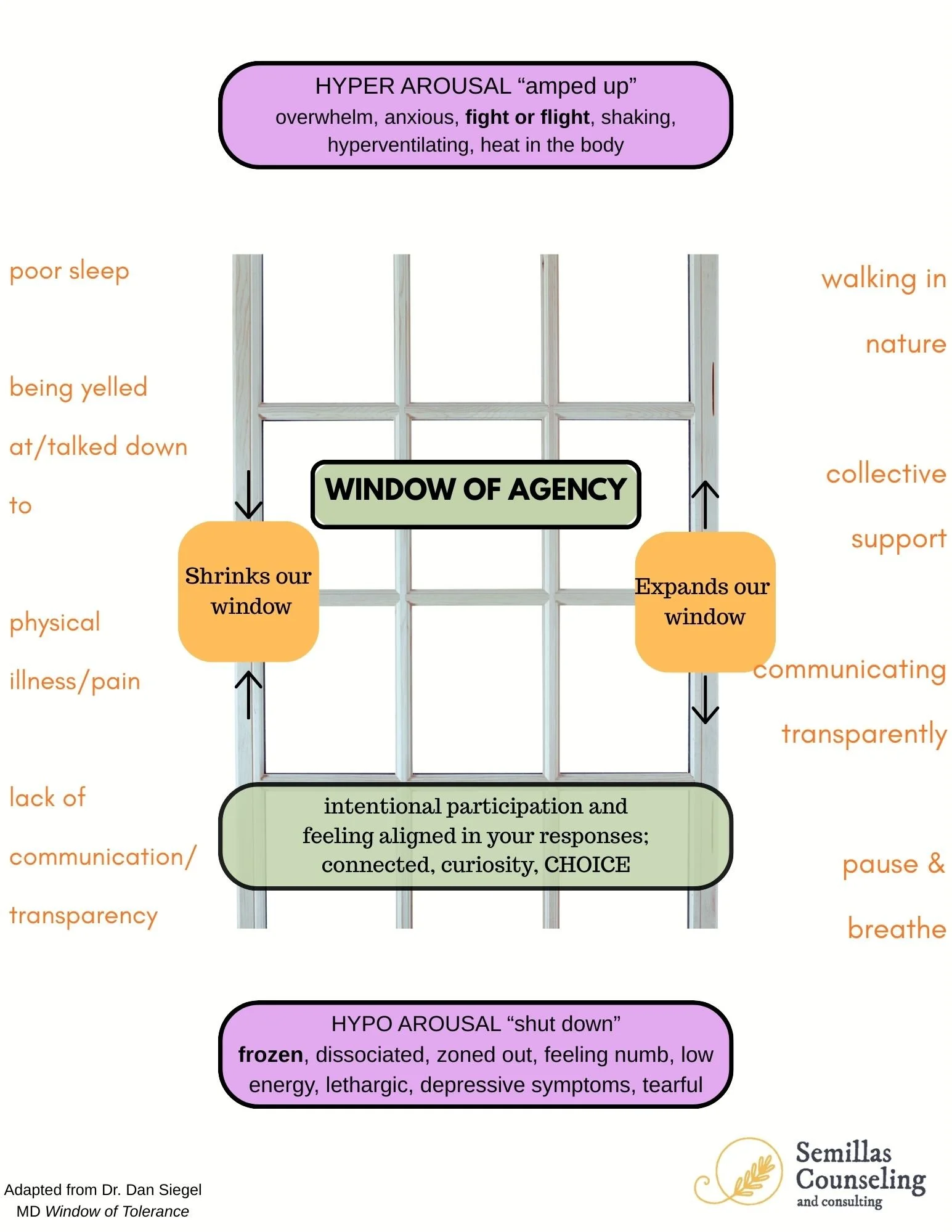
It is valuable to reflect on what expands and grows your window of agency. What practices or invitations can you bring in after experiencing stress or trauma? Equally, it is important to recognize what shrinks your window of agency—what limits your sense of choice? While I have shared some examples above, I encourage you to consider what expands and contracts your own window of agency.
What changes might you want or need to make to increase your agency in the world? What is your responsibility in this social and cultural moment? Are there new ways you wish to move forward?
Shared Accountability and Changing Patterns
Changing established patterns is not easy—it requires heart and dedication. Shared accountability is essential as we work to expand our agency and make intentional choices in response to the world around us. So, now what? What small actions will you do differently? What a fun thing to experiment around and begin observing how small changes impact you and those around you. Imagine for a moment if we all found ourselves acting from or encouraging each other to expand our Windows of Agency?
Others who are inspiring me to create small shifts:
My pal Moque Krape. What I always hear myself saying: “if they weren’t my friend, they would be my therapist.” They are one of a kind and just opened up their own private practice after years of group practice and community mental health work! Get yourself a friend (or therapist!) who can hold you with some accountability and softness all at the same time!
My sweet friend Elizabeth Gillette. She just started a new podcast on Becoming Relational. The episodes are short, sweet, and offer lots to reflect on. She is so embodied and rooted in her work. She makes friendship so fun!
My longtime friend, Amy Monroe. She is a certified personal trainer and is full of wisdom and inspiration on creating supportive habits for consistent impact. I love that our Children our besties!
My amiga querida, Ada Volkmer. No fancy link pero the amistad con este amiga is one of the sweetest surprises in my adult friendships. Ada reminds me to LAUGH, drink cafecito or te, caminar regularly, and take adventures. It only helps that we have similar ancestral roots.
My Children. Kai and Koda stretch me. Sometimes it feels good and others times its hard. They bring me back to PRESENCE all the time. They love to hold me accountable to consistency! They remind me each day how much we all thrive with connection.
Finally, the work and music of Elizabeth McCorvey. My favorite song for troubling times is “Lighthouse”. But you cannot go wrong. Each song elicits a different experience, and they are all worth exploring. Music makes practicing new patterns, routines, and behaviors all the more fun!
So, who inspires you to make little shifts?
We are all just sharing and responding to each other’s nervous systems every day. Who do you want to share nervous systems with? How will you respond?
Your own nervous system is impacting the collective nervous system. We have a role and some agency in the world we are creating!